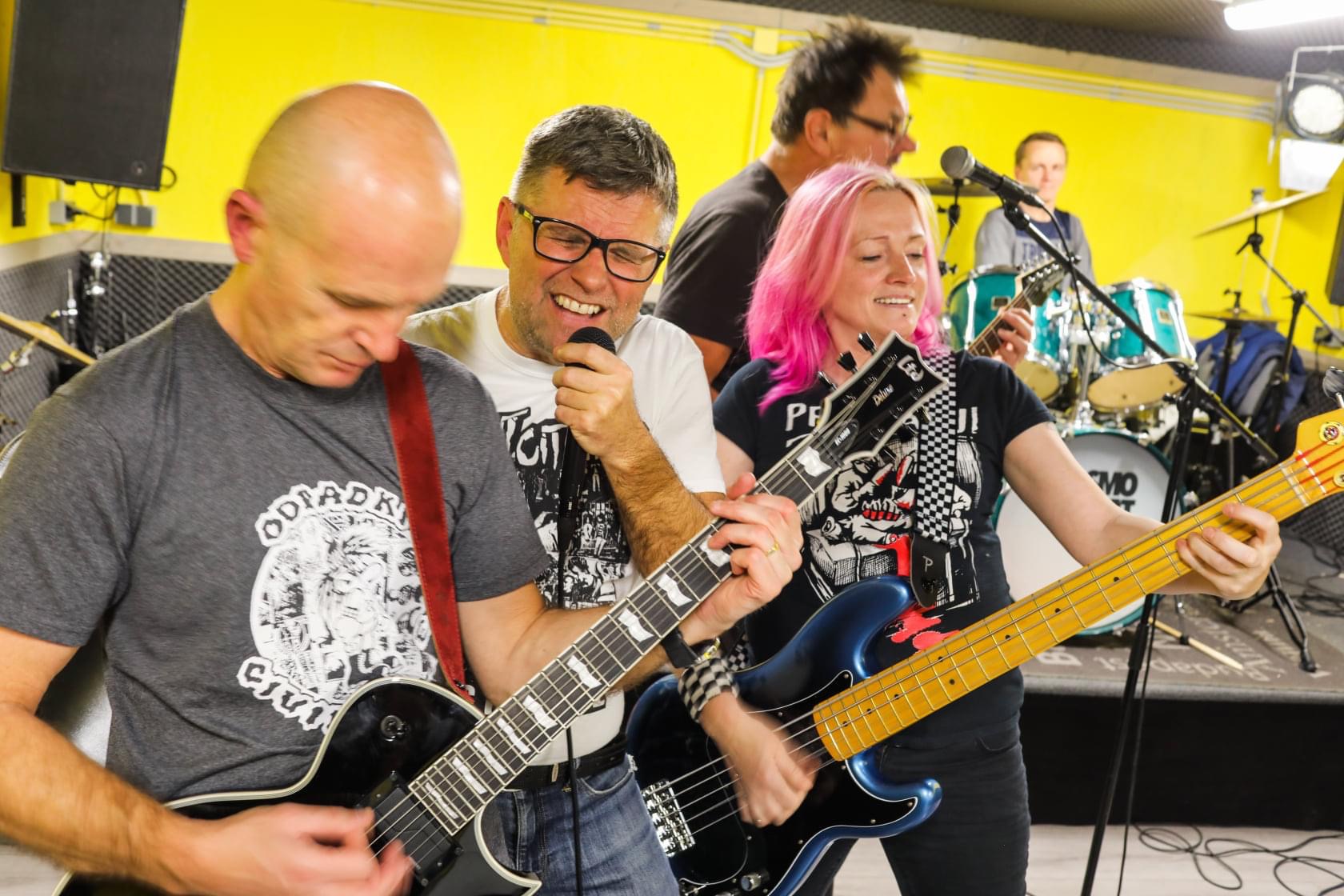
ODPADKI CIVILIZACIJE were ex Yugo hardcore punk band from Ljubljana Slovenia, but also were into the raw and harsh Early (1981), Mid Eighties (1985) Hardcore Punk of that time. Brand members were: Primoz habic, Dare, horvat and samo, second lineup was : Zoki,dare,samo,saj,third lineup was: zoki,Rane,samo,dare,fourth lineup was: zoki,samo,Kristof,Maus.First single was Neo Pakt.Odpadki Civilizacije one live song was recorded on the first hardcore gig in yugoslavia in 1983, previously unreleased. Odpadki civilIzacije had gig with band the Exploited in Šentvid on 1984. The band is also on the legendary compilation Hardcore Ljubljana .The band is reunited in 2021. Now members are: Zoki - vocals, Gazo - guitar, Krištof - drums, Dare- guitar, Skabina - bass. They have done 3 way split with bands Vox populi (Serbia) and Chikara (BiH). Old songs came out on split with Chikara and Vox populi - the ones that were recorded in the 80s and also they have done split with band iritator so do pls Check it https://iritator.bandcamp.com/album/iritator-odpadki-civilizacije-split . Also soon band Odpadki Civilizacije will have gig on 01.04.2022 in Slovenia at Klub Gromka and also they will have more new gigs soon. They will play old songs and new songs also.
Gordi were a Yugoslav heavy metal band from Belgrade. Their initial works were mostly progressive rock-oriented and only their last two studio albums, Pakleni trio and Kraljica smrti
were heavy metal-oriented. However, these are the albums for which
Gordi are generally most remembered and are considered milestones on the
former Yugoslav heavy metal scene.
The band was formed in November 1977 by former Džentlmeni, Fleš and Dah member Zlatimir Zlatko Manojlović.The band's first lineup consisted of Zlatko Manojlović (guitar,
vocals), Zlatko's brother Goran Manojlović (a former Dah and Land
member, keyboards), Stevan Milutinović Steva (a former Dogovor iz 1804,
Moira and Dah member, drums) and Dragan Janković (a former Buket Mojih
Prijatelja member, bass guitar). After Zdenko Pomper (a former Dah
member) replaced Janković on bass guitar, the band released its debut
album Čovek (A Man) in 1978, through ZKP RTLJ.Album featured song "Misli" ("Thoughts"), which was previously released
on the B-side of the single "Žeđ" ("Thirst"), the last single released
by Manojlović's previous band Dah. The album was progressive rock-influenced and in an interview for Rock Express Zlatko Manojlović described the band's sound as "psychedelic". Soon after the album release, Pomper was replaced by Slobodan Svrdlan, and Gordi released their second studio album Gordi 2. the album was released in 1979 through PGP-RTB. While the band's first album was mainly progressive rock-oriented, Gordi 2 featured more hard rock elements. In 1980 Zlatko Manojlović released his first solo album Zlatko i njegove gitare, and in 1981 the band released their third studio album Gordi 3 through PGP-RTB.Although progressive/hard rock-oriented, Gordi 3 also featured pop music elements.The same year, Gordi performed as the opening band on Ian Gillan Band concert in Belgrade Pionir Hall.
In 1981, Gordi became a power trio, after Stevan Milutinović was replaced by Čedomir Petrović "Čeda" (a former Bicikl and Siluete member), and Goran Manojlović left the band. The band signed for Jugoton and released the album Pakleni trio (Hell Trio) which marked Gordi's shift towards heavy metal. In 1982, the band released their second heavy metal-oriented album, Kraljica smrti (Queen of Death), however, they failed to sustain their popularity and disbanded two years after the album release.
Post breakup
Manojlović dedicated himself to his solo career. Svrdlan became a member of the heavy metal band Ratnici, releasing two albums with them. In 1983, he played bass guitar on U Škripcu album O je!. In the early 1990s he was a member of the American band Lost City, recording the album Watching You (1993) with them, and in the late 1990s of the British band Michael Aston's Gene Loves Jezebel, recording the album Love Lies Bleeding (1999) with them. In 2005, he appeared as a guest on Generacija 5 album Energija (Energy), playing bass guitar on five tracks.
In 1994, the song "Put do pakla" ("Road to Hell") was released on Komuna compilation album Pakleni vozači: Jugoslovenski hard rock (Hell Riders: Yugoslav Hard Rock). In 2006, Rock Express Records rereleased Pakleni trio, featuring four videos as bonus material. In 2007, the same record label rereleased Kraljica smrti, featuring three videos as bonus material.
This post will be different. This post will be about HCR BadgesProduction & Distribution. Badges are one of the most cost-effective promotional items available
today, making them a perfect giveaway tool. If you have a limited
marketing budget for your campaign,badges are an ideal choice,
especially if you’re in need of a large quantity of items. Give them
away at events, tradeshows or large conferences or gatherings.HCR badges can be made in an endless variety of shapes, styles and colours
to suit your style. To help your badge stand out from the
rest, consider a creative, eye-catching design. Don’t forget about the
size – try creating a clever oversized badge or even a mini-badge.People love button badges! Badges raise awareness because they get
noticed – many people wear them on coats, hats, backpacks or laptop
bags. A lot of people today even collect them and proudly showcase their
entire collections.Treat your loved ones with the best hardcore, punk, crust, grind,metal,noise badges. Price is nothing , 1 euro per piece! More information on:
TOŽIBABE
was a Slovenian all female hc/punk band from Ljubljana, active during
80s in former Yugoslavia. Members were Alenka Marsenič Marsa (bass,
vocals, drums, guitar), Lidija Rupnik (drums, bass) and Krischka
(guitar, vocals, bass).
Pekinška Patka (Serbian Cyrillic: Пекиншка Патка; trans. Peking Duck) is an eminent Serbian and former Yugoslav punk rock band from Novi Sad. Their debut album, Plitka poezija,
released in 1980, is considered the first punk rock album by a band
coming from Serbia. Being one of the first punk acts in Yugoslavia, they
played a major role in opening doors for many bands that came after.
On their second and last album, Strah od monotonije, released in 1981, they turned towards post-punk and darkwave sound, disbanding during the same year. In 2008, the band reunited to perform on the main stage of Exit Festival alongside Sex Pistols, and in 2010, they reunited once again, continuing their activity.
Pekinška Patka's roots are found in Trafo, a short-lived cover band
formed in 1976 by electric guitarist Sreten Kovačević with Nebojša
Čonkić providing the vocals. Further featuring Štrc on bass and Zare on
drums, the band performed rock standards covers of The Rolling Stones, Santana, Deep Purple, etc. The following year, Kovačević formed Café Express, a pop
band featuring Čonkić as guest vocalist in addition to Boba Mama on
guitar, Aleksandar Čerevicki on keyboards, Aleksandar Kravić on bass,
Laslo "Cila" Pihler (Shital Puri) on drums, and vocalist Aleksandar
Krstić.
During early summer 1978, Čonkić (nicknamed Profesor Čonta), at the time 25-year-old teacher at Mihajlo Pupin High School in Novi Sad, visited London where, among various acts, he saw The Clash, The Specials, Midge Ure, Glen Matlock's Rich Kids, The Skids, and Magazine perform live, before returning home to Yugoslavia full of impressions and ideas about putting together a band with a new sound.
In July 1978, Kovačević, drummer Laslo "Cila" Pihler, and Čonkić
decided to form a punk rock group inspired by the British punk bands.
The first lineup also featured bass guitarist Miloš "Žure" Žurić. The
band held rehearsals at the University of Novi Sad's
Faculty of Mechanical Engineering building where their first live
performance took place. Four people attended the gig, all of them
friends of the band members. After that, Čonkić and Kovačević started
working on new material, mainly in Serbian language. Soon, Srbislav
"Srba" Dobanovački became the new bass guitarist.
Local prominence in Novi Sad
The
band's first official live appearance took place in December 1978 at
Novi Sad's Klub 24 venue and immediately got the local public talking
due to the commotion it raised among the club's staff who were
sufficiently shocked by the performance that they decided to put a stop
to it, sending the crowd of about 200 youngsters home. The immediate
reason was the band's performance of an impromptu vulgar punk cover of a
communist youth work action song featuring the modified lyrics "Brižit Bardo bere čičke; Vidi joj se pola pičke" ("Brigitte Bardot is picking thistles; half of her pussy is hanging out").
The band based their act on melodic punk
and vivid public image with high-energy live shows featuring constant
jumping and gyrating that had a strong effect on the young crowds. Being
one of the first groups in the country with this kind of sound and
performing style, they attracted media interest before releasing any
material. Čonkić often used those media appearances for self-promotion,
delivering sweeping statements like: "We're the first important thing to
happen to Yugoslav rock since the days of Ivo Robić and Marko Novoselić". He also purposely courted controversy with soundbites such as referring to his group as the "first Orthodox punk band", which went against the doctrine of the ruling Communist League (SKJ) that very much promoted atheism in Yugoslav society.
The band quickly developed a cult following among the sections of
Novi Sad youth who expressed their devotion by spraying "Čonta je Bog"
("Čonta is God") graffiti
throughout the city. All of this unconventionality also got the band
plenty of attention from local communist authorities who saw subversive
and incendiary potential in their sound and appearance. As a result,
despite generating a lot of interest, not only in the city but also
throughout other parts of Vojvodina,
the band experienced problems with live performances, many of which
would get canceled on the day of the show on suggestions from the
authorities.
In December 1978, the band played the last BOOM Festival, which was being held in their hometown that year.
Wider popularity and first releases
The band appeared at the Festival Omladina with the song "Bela šljiva". Vesna Vrandečić (later to join Xenia)
won the festival's main award, but Pekinška Patka got the Audience
Award. Their whole performance was broadcast on national television
which was the first TV appearance of any punk band in Yugoslavia. This raised their profile as far as Yugoslav recording companies were concerned; they started negotiating with PGP-RTB
label about a debut album, but ultimately could not reach a deal. The
band continued playing and soon developed a wider following in bigger
Yugoslav cities: Belgrade, Sarajevo and Zagreb. They eventually signed with Jugoton after its representatives saw them perform at Zagreb's Kulušić club.
The first Pekinška Patka release became a vinyl 7-inch single (2-side) "Bela šljiva" / "Biti ružan, pametan i mlad"
produced by Slobodan Konjović. Relatively good reception of that
single, with 35,000 copies sold, paved the way for them to begin
recording a full-length debut album.
In October 1979, the band was invited to perform in the village of Stepanovićevo at the anniversary celebration of the end of World War II. The band performed their standard set-list and the show also featured blowing of condoms and throwing them to the audience as well as swearing
on stage that was met with a mixture of shock and delight by the
audience. Another punk rock band, Gomila G (a censored version of their
original name Gomila Govana, trans. Pile of Shit), which played as the opening act, performed the song "God save Martin Bormann",
which was also the reason why the authorities and the media turned
against the two bands. Soon after the show, Gomila G bassist Borislav
"Bora" Oslovčan joined Pekinška Patka as replacement for Dobanovački.
Together they recorded a demo, consisting of seven tracks, which was
unofficially released during the 1990s. The new lineup also performed at
the Leto na Adi manifestation, which was held at a luxurious raft at Ada Ciganlija, with the song "Poderimo rock". Since the crowd rushed to the stage and jumped around, the raft almost sank.
The album Plitka poezija (Shallow Poetry), a punk rock material with occasional ska elements and humorous lyrics, was completed by fall 1979, but Yugoslav president Josip Broz Tito's illness postponed the release until summer 1980. It was ushered in by another 7-inch single, "Bolje da nosim kratku kosu" / "Ori, ori". The whole material was recorded in the Boris Kovač studio, outside Novi Sad, and was produced by Slobodan Konjović, well known disc jockey from Studio B radio station. Eventually, their debut album was released in 1980 and sold about 15,000 copies, which Jugoton considered a failure.
One of the first live presentations of the new material was at the Split festival with the band Azra.
Several thousand people attended the concert. The relations within the
band were somewhat strained at this gig. Dissatisfied with the band's
decision to go on tour of Bosnia and Herzegovina,
bassist Oslovčan played with his back turned to the crowd, while
actively sabotaging the proceedings by purposely making the band sound
as bad as possible.
Lineup changes, post-punk period
Following
the debut album release, the band went through some personnel changes
with some members changing instruments and others leaving altogether.
Guitarist Kovačević expressed a desire to play saxophone
so he moved to that instrument while new member Zoran "Bale" Bulatović,
a 17-year-old Pečat member, took over the vacated guitar spot. Second
guitarist Prosenica, and bassist Oslovčan also left the band. Oslovčan
was first replaced by Aleksandar "Caki" Kravić and then the former
bassist Srba Dobanovački until Marinko Vukmanović joined the band.
Prosenica's spot stayed vacant as the band continued with only one
guitar. That lineup did not last long as Kovačević left the group during
fall 1980 to form his own band, Kontraritam.
The new lineup went on the successful Bosnia and Herzegovina tour, ending with a sold-out show at Sarajevo's Skenderija Hall. The band recorded the cover of the popular Dragan Stojnić chanson "Bila je tako lijepa", with altered lyrics, and released it on single with "Buba-rumba" as the B-side. Another cover version, this time The Hollies' hit "Stop! Stop! Stop!", appeared on the "Rokenroler" show broadcast on TV Belgrade. The song was used by JRT (Yugoslav Radio Television) station for representing Yugoslavia at the Montreux Rose d'Or festival. Čonkić also planned to cover the "Hymn to Saint Sava", which was not approved by the rest of the band.
During December 1980, the band performed at the Grok festival held at the Novi Sad Fair. The band left a good impression, but also caused an uproar by burning a copy of the Borba newspaper. During the intro for the song "Biti ružan, pametan i mlad", Čonkić said that the song was dedicated to Bijelo Dugme leader Goran Bregović. Soon after the show, Dnevnik journalist Bogdan Četnik wrote an article demanding the band to be completely banned.
From October 1980 until March 1981 the band prepared new material inspired by Joy Division, The Stranglers, The Cure and Magazine. The band changed the style to post-punk and dark wave, presenting a different sound and image, which mostly failed to connect with the audiences the way their debut did. The album Strah od monotonije (Fear of Monotony), released in May 1981, was sold in about 8,000 copies.
The band performed rarely and their last notable shows were at a large concert at Zagreb Velesajam (performing with Riblja Čorba, Haustor, Film, Prljavo kazalište, Leb i Sol, Parni Valjak, and other bands) and the Kalemegdan park which was their last concert, During the summer, Čonkić went to serve the Yugoslav People's Army and by the time he returned, Bulatović was already the member of Luna and Vukmanović formed the pop band Primavera.
Post-breakup and reunions
In 1994, Čonkić emigrated to Toronto, Ontario, Canada with his family and, after working as a pizza deliverer and computer programmer at Canada's state broadcaster CBC, he got a job as lecturer at Seneca College in Toronto. Bulatović moved to New York City during the 1990s.
In 1997, their complete discography, including singles and albums, was re-released on CD format by Croatia Records
(legal successor of Jugoton). Then on July 5, 2006, the same was done
by Serbian Multimedia Records at which time the band got a significant
promotional push from Serbian web magazine Popboks.
On May 28, 2008, it was announced that Pekinška Patka would be reuniting to perform at the 2008 EXIT festival. Their performance took place on EXIT main stage on Sunday July 13, 2008 - the festival's closing night - together with Sex Pistols, The Hives, and Ministry.
Pekinška Patka played a 40-minute set consisting of old favorites. In
the interviews immediately after the reunion performance, Čonkić left
the door open for a full comeback.
After pulling out of a Novi Sad performance for New Year's 2010,
the band decided to reconvene again for a show on 21 May 2010 at
Belgrade's SKC
in order to celebrate the 30th anniversary of the "Bila je tako lijepa"
single release. The band reunited in the lineup which recorded the
single and the second studio album, Strah od monotonije, and after the Belgrade performance, they played at the Zagreb Boogaloo club.
On May 5, at a press conference, the band announced the release of a cover album, featuring songs performed at the Yugoslav 1960s pop festivals such as the Opatija, Beogradsko Proleće and Vaš Šlager Sezone.
A few days before the upcoming concert in Belgrade, the first
lineup guitarist, and the co-founding member of the band, Sreten
Kovačević, announced suing the band over the usage of the name Pekinška
Patka as well as the performance of the songs from the Plitka poezija album for which he is credited as author in SOKOJ (The Serbian Copyright Protection Organization).In the response to the announcement, the band responded at the Long
Play record label official site with the explanation that Čonkić has the
right to the band name, and that on July 1980, without previously
informing the rest of the band, Kovačević had signed co-authorship to
the debut album tracks at SOKOJ, thus the information on the authorship
and at SOKOJ mismatch.
Both the Belgrade and Zagreb performances featured the band playing most of the tracks from Plitka poezija,
with the exception of the song "Bolje da nosim kratku kosu" written by
Kovačević according to SOKOJ, the upcoming single, the cover version of Luz Casal song "Un año de amor", and the song "Neko", from the second album Strah od monotonije. However, the Belgrade performance did not feature Pihler on drums, and the substitute drummer was Veliki Prezir drummer Robert Radić.
In December 2010, the band released a free digital download MP3 version of the single "Un año de amor" on the Long Play record label official site.
Former bassist Borislav "Bora" Oslovčan died on October 5, 2017 at the age of 56.
KUD Idijoti was a punk rock band from Pula, Croatia. The name of the band translates to Cultural Artistic Society "Idiots" The word Idijoti is deliberately spelled wrong, the correct Croatian form of the word being idioti. The prefix 'KUD' meaning "cultural-artistic society" was widely used in SFR Yugoslavia as a designation for folklore groups.
The band was formed in 1981 and released its debut album in 1986. In 1987 they won the Youth Festival prize in Subotica in competition with over 300 bands and quickly gained recognition as one of the most popular bands on the punk scene of the former Yugoslavia.
After winning the first prize they have gained international
popularity, performing live in Switzerland, Germany, Hungary and Italy.
Particularly in Italy in Reggio Calabria, the festival of Mediterranean countries almost turned into an international incident, after carabinieri stopped the performance of the famous communist song Bandiera Rossa.
Their compilation album, "Bolivia R'N'R", compilation of the
first three singles and three previously unreleased songs, was published
in January 1990 by the independent German record label "Incognito
Records." In May of the same year they published the next album "Mi smo
ovdje samo zbog para" (We are Only Here for the Money), which
until now went on to become their biggest selling album. Due to the
breakup of Yugoslavia, the release of their third album, "Glupost je
neuništiva" (Stupidity is indestructible) was briefly delayed,
and consequently released at the end of 1992. Next year they published
the album "Tako je govorio Zaratusta" (Thus Spoke Zaratusta), which was also their first album was released on CD. This album contains on one of their most famous songs: "Za tebe" (For You), and the cover of the Italian partisan song Bella Ciao.
In 1994, the band went on tour in Germany, Switzerland and Macedonia, and they performed at Sziget Festival in Budapest. Another significant performance was held on 10 October of the same year in Ljubljana's Tivoli Hall, where KUD Idijoti played as the opening act for the American punk rock band Ramones.
In 1995, the band released the album Istra ti materina (hr) (wordplay of a very common curse and "Mother Istria") in collaboration with the Pula composition band Gori Ussi Winnetou. Immediately after releasing the album, Radio Pazin was banned because of its broadcast of the song "Turbo Cattolica" which mentions Pazin Inquisitor.
1995 and 1996 saw the creation of another two studio albums, LP
"Megapunk" and EP "Fuck". Megapunk and Fuck received positive critical
reviews. In early 1997. band signed with the record label Dancing Bear,
and released the album "Cijena ponosa" (Price of pride). In 1999
they published "Gratis hits live", the album with appearances in club
Uljanik Pula, on the occasion of the band's 18th birthday. KUD Idijoti
remained popular in other countries of the former Yugoslavia, and have
frequently toured throughout its former member republics.
"Remek djelo" (Masterpiece), their last album, was published in 2001 and followed by the promotional concert tour.
Apart from Franci Blašković, band members have collaborated with Peter Lovšin, singer of the Slovenian punk band Pankrti, Šajeta and Hladno pivo.
In 2011, Singer Branko Črnac "Tusta" was diagnosed with lung and
throat cancer, and the band went on an indefinite hiatus. A number of
humanitarian concerts were organised which were used to raise funds to
help with the treatment, but Tusta died on 14 October 2012 from this
disease, at the age of 57.
A few days following his death, the lead guitarist and founder of
the band, Sale Veruda, declared that with the death of Tusta KUD
Idijoti as a band have ceased to exist.
Band Members
Branko Črnac Tusta - vocals
Saša Milovanović, a.k.a. Sale Veruda - guitar, back vocals
Badmingtons (in Macedonian language: Бадмингтонс) were a prominent Macedonian punk rock band.Badmingtons were formed in 1983 in Skopje, then SR Macedonia (now the Republic of Macedonia) by Vladimir Petrovski - Karter (guitar and vocals), Dean Škartov - Deko (keyboards) and Boris Georgiev - But (drums).
Previously, Karter had played in one of the line-ups of Fol Jazik (the first punk band
in Skopje, formed 1978) and later in Saraceni, another legendary punk
group, which also featured the now-internationally acclaimed musician Goran Trajkoski.
Boris Georgiev was a former drummer in Jadro, which included members
from several countries, as well as in the bands Pop and Dizajn. He
visited London in the 1970s where he acquainted himself with the punk movement. Since purchasing his Yamaha CS-15 electronic keyboard
in the late 1970s, Deko initially played in the group Kocka led, but
later, in 1983 he joined Karter and But to form Badmingtons.
In 1984 Badmingtons recorded their first demo tape, and got the first prize at the Macedonian demo bands competition Rokfest, which gave them an opportunity to record in the acclaimed M-2 studio of the music production branch of the national Macedonian Radio-Television.
They recorded several songs, one of which was their trademark track
"Site obični luđe" ("All the common people"). The new recordings were
joined together with the previous material and released as the demo
album titled "Posle mene što ti e gajle"
in 1985. "Site obični luđe" became a Macedonian punk anthem and later
was covered by several other artists including the notable alternative rock group SunS in the 1990s. Badmingtons were also included with this song in the Makedonski dokument (Macedonian Document) compilation album along with other notable underground music acts. The style of Badmingtons is a straightforward punk rock, however occasionally they would go beyond the style into a sort of experimental rock. As well as Posle mene shto ti e gajle, the group also issued an EP called Intimno tetoviranje, featuring "Site obichni lugje" and four Serbian-language songs.
Badmingtons ceased to exist in 1986 and transformed themselves into a new band called Aleksandar Makedonski (Alexander The Great). The new band were initially a more pop-rock oriented act and also included some new additional members. Their debut album "Za heroje i princeze" was released for Jugodisk record label in 1988 in Serbo-Croat, because it was the most widespread language in the multilingual former Yugoslav federal market. In the same year, Boris Georgiev left them and joined the gothic rock cult band Mizar and played drums on their first self-titled album in 1988. Deko remained in Aleksandar Makedonski until 1988. Later he was member of the psychedelic rock group Kleržo until 1991, when he left the country for Italy, where he spent several years before returning. On the other hand, Karter lived in Germany
for a while and continued to work with Aleksandar Makedonski after
coming back to Skopje. In the early 1990s they recorded several songs in
the studio of Kokan Dimuševski (of Leb i sol), one of them being a duet with Goran Tanevski of Mizar. Karter performed at the Strip & Sound festival in Skopje in 1995. One year later Aleksandar Makedonski released the album Moeto carstvo. The lineup on Moeto carstvo
can be seen as a Badmingtons reunion of sorts, due to all three
original Badmingtons members playing on the album. In 1997 Karter formed
a new band called Opstrukcija, which released the album Sistem.
In 2002 Badmingtons briefly reunited for the summer open-air festival Alarm held in Ljubaništa on the Ohrid Lake, Ohrid Municipality, where they shared the main stage with the famous British punk band UK Subs and other prominent acts on 13 July.
Badmingtons gathered for a one-off reunion after their music was used for the soundtrack of the feature film Prevrteno
(Upside Down) directed by Igor Ivanov - Izi in 2007. The reunion
concert took place in the Youth Cultural Centre (MKC) in Skopje on 3
December 2007 as a part of the Taksirat festival annually organized by Lithium Records.
Necrophilia is Punk band from Belgrade, Serbia (in that time part of
Yugoslavia). They used to play in the 80's and they are featured on the
"Buka i urlik" compilation-tape with Herpes Distress and Solunski Front.
Ženevski Dekret is a legendary punk rock band from Mostar. The name
was inspired by Reagan (USA) and Gorbachev (USSR) negotiations on the abolition
of the nuclear program and the establishment of friendly (or better-say-less
hostile) relations between the two countries. Negotiations were held in Geneva,
so this agreement was remembered as the "Geneva Decree". Beginning
1985 as HC / Thrash trio, influenced by some bands from that time. Because of
the continuous change within the band, the band's sound changes from thrash
through melodic HC to punk / rock. The first album - "Mostar" -
was recorded in 1986 in Ljubljana (Slovenia) in the Borut Cinc studio with 8
tracks. It was released in 1987 and debuted as number one at several local
radio stations. After the release of their first album, Kokic (singer) leaves
the band for personal differences with the remaining members. Another album
-"ne želim biti dio jebene mase" - 1988 was recorded in Sarajevo
(studio Vogue), 6 songs. With the new singer and new approach (Habi / Đoko /
Golub / Geno), a wider range of musical styles and influences is noticeable
than in earlier works. At the end of the mix in the studio there was a pile of
Sarajevo punk rockers, led by Dude and Dan, with wine wraps ... and they of
course forgot that in the future anthem and far the best song"I do not
want to be" puts on a background vocal !!But without them it was okay,
that was the best, most famous, the worst, the most talked about Ženevski
Dekret. The band also has the smallest concerts in Sarajevo, Gospić, Dubrovnik,
Mostar ... The band will only get a good critique and the song "Necu da
budem dio jebene mase" has become a big hit not only in punk circles. The
songs from that bull went around everywhere, they made a tune of compilations..
In April 1989, however, we managed to gather and maintain the only performance
in this setting at the Sarajevo Academy of Performing Arts together with the
Rijecka group Grch. The concert went quite well with the wacky audiences
raiding and Krizino's tear-throwing. It was not just the audience who had a lot
of fun at this. They were scooped with a crowd in a narrow alley,
suddenly dropped through the curtain, into the backstage, right at the table
they sat and drank the guys from Grcha (who then insisted on naming the band in
ex-YU). They thought they were in the final preparations for coming to the
scene when I unplugged them with their unannounced fall, ha ha! What is this?
What does it really do? They could have read that stupidity on their faces. I drank
with the confused Zofo, singer Grch, took some beer and squeezed from the table
back to the scene. This whole set did not last for more than 10 seconds, but
this scene will be recalled as one of the most entertaining concerts
they"ve ever had. And there were a lot of them. This performance will be
the last time this setup was made by ZD.The attitude and style Ženevski Dekret,
as well as their music, strongly influenced many other Balkan punk rock bands
from the 1980s. In 1996, three members met in Sweden accidentally and in March
1997 recorded their third album "10 Years". With the new guitarist it
was a bit different from the previous one, they came back to their roots, and
the sound approached the old punk. Their influence continues in other Balkan
PUNK & HC bands. In 2006, Ženevski Dekret was finally reunited. They
released the fourth album "Best Of" (1985-2006) remastered -
compilation of all the best songs with the new single "Alcohol". In
2007, the EP is "Necu da budem dio jebene mase" in a limited number
of 500 copies and that has become a real and very sought after rarity.
First, I will say something about my blog, which
may bore you a little after which I will move on to this particular band. After
that, I will try to write about bands that marked the punk scene of ex
Yugoslavia as well as worldwide. I will also try to illuminate some new bands
and the underground scene, predominantly punk bands, but metal, hard-rock,
hardcore will not be missed. The purpose of the blog is to connect people and
bands, to hear about each other, support and possibly hang out at all mad
future gigs.
So
Via Ofenziva is a Slovenian postpunk band from Ljubljana . They
worked in the first half of the 1980s. They performed musically under the
influence of punk and postpunk. The members of the band were Esad Babačić,
Zoran Železnik, Ivo Frančič, Robert Fritsch (Frič) (later playing in blues ,
boogie and rock'n'roll with Don Mentony Band ) They started their career days
at the cult discoclub FV. In the FV were the Borghesia and
Buldožerji , then Cao Pička , and later the Orkester Titanik , D'Pravda ,
Otroci socializma, Gas't'rbajtr's ( Demolition Group), Disciplina kičme,
Videosex, O!kult and others. They published the 1983 split edition
together with Cao Pička . Songs on the A side of the tape: Da Ti Rasfukam, Moj
Pir, Okna, Mrtvi Igralci, Minimalni Ritem, Po Mojoj Lijevoj Nozi, Jugoslavija,
Proleter and Lily Marlen.. The album announced the pledge of ŠKUC ( Študentski
kulturni centar ), which announced the Laibach and punk compositions such as
Borghesia 2006 compiled CD compilation. The bands like Čao Pičke,
Niet, Via Ofenziva, Berlinski zid, U.B.R., Šund, Kuzle, Buldogi, Lublanski psi,
Otroci socializma, Tožibabe, Indusbag,O!Kult, Odpadki Civilizacije, , fall into
the cream of the Slovenian punk.The song of this composition Proleter is
one of the greatest hits of the Slovenian punk. The Songs of See and Control
of Minds are on the compilation of ZKP RTVLJ Novi Punk Val from 1981.